
| Scope | How pentest methodologies, frameworks, knowledge bases, and threat models differ; PTES, OSSTMM, CREST, MITRE ATT&CK, OWASP Top 10 and MASVS, the Purdue ICS model, and STRIDE, DREAD, and OCTAVE. Does not walk through tool commands or write a full report template. |
|---|
Clients ask which methodology you follow. PTES is a pentest lifecycle. CREST is an accreditation body. MITRE ATT&CK is a catalog of how adversaries behave. OWASP Top 10 is an awareness list, not a test plan. Treat them as interchangeable and you over-promise coverage, or you write a report the blue team cannot turn into detections.
These are also the testing frameworks and methodologies listed under CompTIA PenTest+ PT0-003 Objective 1.3: OSSTMM, CREST, PTES, MITRE ATT&CK, OWASP Top 10, MASVS, Purdue, DREAD, STRIDE, and OCTAVE. The comparison below is useful for real engagements and for certification prep.
This is a writing-only guide. Pick the stack that matches the scope, name it in the RoE, then do the technical work in later lessons.
Methodology, framework, and knowledge base
People use "methodology" and "framework" as synonyms in sales decks. For PenTest+ and for a defensible engagement, keep the jobs separate:
| Term | What it gives you | Example |
|---|---|---|
| Methodology | Ordered phases from kickoff to report | PTES, NIST SP 800-115 assessment process |
| Framework / standard | Categories, controls, or verification requirements to test against | OWASP MASVS, CREST Application Security Testing, OSSTMM channels |
| Knowledge base | Observed adversary tactics and techniques | MITRE ATT&CK (Enterprise, Mobile, ICS) |
| Threat model | How you invent and rank abuse cases before or during the test | STRIDE, DREAD, OCTAVE |
| Accreditation | Buyer assurance that the firm and testers meet a competency bar | CREST membership and exams |
You can finish a pentest with PTES and never mention ATT&CK. You cannot run ATT&CK "instead of" PTES and still cover pre-engagement, RoE, and reporting.
NIST SP 800-115 sits next to PTES as a planning guide many regulated buyers recognize. The comparison table and PTES vs NIST section below cover it alongside the PT0-003 objective list.
Quick comparison
Use this table to pick a primary reference, then read the section for the ones that apply to your scope.
| Reference | Job on the engagement | Best fit | Weakness if used alone |
|---|---|---|---|
| PTES | End-to-end pentest lifecycle | General network, mixed-scope, and exam study structure | Little web-app test-case depth; last major public revision is old |
| NIST SP 800-115 | Planning, executing, and reporting technical security assessments | Government, enterprise, and audit-oriented assessments | Older publication; less application-specific than OWASP |
| OSSTMM | Measure operational security across five channels | Physical, human, wireless, and telecom in the same audit | Heavy metrics (RAV); overkill for a two-week web test |
| CREST | Organizational accreditation against CREST standards | UK and many regulated buyers; app testing via CREST Application Security Testing | Not a phase list; you still write a methodology |
| MITRE ATT&CK | Map and emulate adversary behavior | Red team, purple team, detection-gap language in reports | No scoping, RoE, or report template |
| OWASP Top 10 | Awareness ranking of web risks | Talking to developers; coverage reminder | Ten categories are not a methodology |
| OWASP MASVS | Mobile app security verification controls | iOS and Android assessments | Web and network tests need other guides |
| Purdue model | ICS/OT architecture levels for scope | Plants, SCADA, manufacturing networks | Not a pentest process |
| STRIDE / DREAD / OCTAVE | Threat identification or risk workshops | Design reviews and ranking discussions | Not a substitute for exploitation and reporting |
PTES vs NIST SP 800-115
PTES gives penetration testers a seven-phase, practitioner-oriented lifecycle from pre-engagement through reporting. NIST SP 800-115 organizes security assessments around planning, execution, and post-testing activities. It is the reference many government and enterprise buyers expect when they ask for NIST-aligned testing documentation.
Use PTES when you need a clear offensive workflow. Use NIST SP 800-115 language when the SoW or compliance program names NIST explicitly. Most firms still run a PTES-shaped test and cite 800-115 in the methodology section for auditors.
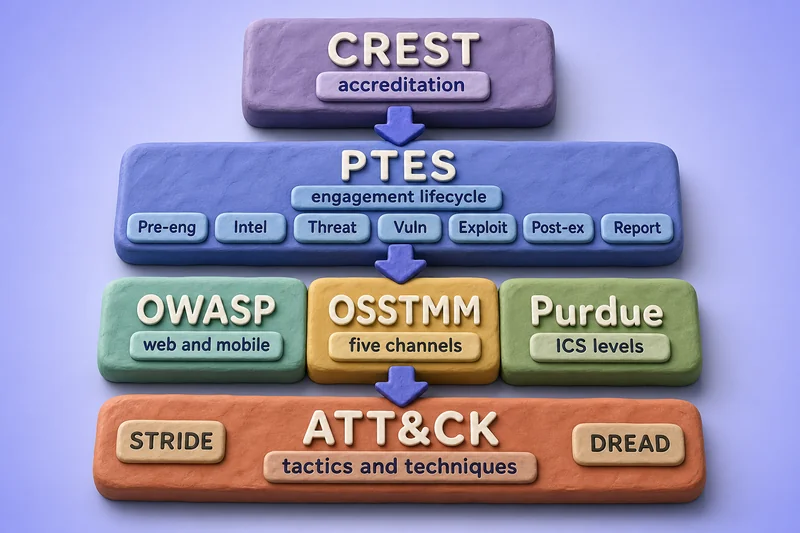
I use this stack in kickoff calls. PTES (or a firm playbook that looks like PTES) is the spine. Everything else hangs off a phase or a target type.
PTES seven-phase lifecycle
The Penetration Testing Execution Standard is the shared outline most firms can explain without a custom slide deck. Practitioners wrote it because every shop had invented a different phase list. The seven sections are:
- Pre-engagement interactions
- Intelligence gathering
- Threat modeling
- Vulnerability analysis
- Exploitation
- Post-exploitation
- Reporting
PTES does not tell you which Nmap flags to use. A companion technical guide exists, but the standard itself is about what work happens in which order. That is why it shows up in pre-engagement scoping as the place you build RoE, and why reporting is its own phase instead of an afterthought.
When I write a methodology paragraph in an SoW, PTES is usually the skeleton:
Methodology: PTES-aligned engagement.
Pre-engagement and RoE before any scanning.
Intelligence gathering and vulnerability analysis against
in-scope CIDR and URLs only.
Exploitation and post-exploitation only where the RoE permits.
ATT&CK technique IDs in the attack narrative.
OWASP WSTG coverage for in-scope web applications.
Two caveats you should say out loud to the client:
- The public PTES wiki has not had a large formal revision in years. Treat it as structure, then layer current technique from OWASP, ATT&CK, and your own lab practice.
- Threat modeling in PTES is a phase, not a Microsoft STRIDE workshop. You still choose STRIDE, attack trees, or a lighter abuse-case list inside that phase.
OSSTMM operational security measurement
The Open Source Security Testing Methodology Manual (OSSTMM 3) comes from ISECOM. It tries to measure operational security instead of collecting a pile of CVEs. An OSSTMM audit looks at five channels:
- Human (social engineering, process, personnel)
- Physical (doors, badges, site access)
- Wireless (RF, not only Wi-Fi)
- Telecommunications
- Data networks
The distinctive output is the Risk Assessment Value (RAV) family of metrics. The idea is that two tests a year apart should be comparable, which a "we found 14 highs" report is not.
Use OSSTMM when the client actually bought a broad operational audit. For a web-only assessment, physical and human channel modules usually add scope the client did not request. Put those channels in the RoE as in or out; do not assume OSSTMM means you may phishing-test the helpdesk.
OSSTMM is also where exam questions about "scientific" or "quantitative" testing usually point. If the stem talks about channels and operational security rather than exploitation phases, think OSSTMM, not PTES.
CREST accreditation and defensible testing
CREST is a not-for-profit that accredits organizations against CREST standards and discipline requirements. Buyers use CREST accreditation as independent assurance that a provider has met CREST's organizational and service-specific requirements.
CREST does not give you a seven-phase pentest plan, a replacement for RoE or an SoW, or a promise that every test will use PTES or OWASP.
In practice you get:
- Company accreditation and a skilled-persons register
- Individual certifications at several levels
- The CREST Defensible Penetration Test (CDPT) discussion of commercially defensible assurance (scoping, sign-off, competency)
- CREST Application Security Testing (commonly referenced through the CREST OVS programme), which assesses organizations against OWASP ASVS and MASVS Levels 1 and 2
In the UK and several other markets, CREST also sits under government schemes (for example NCSC CHECK). For PenTest+, remember the exam objective is "testing frameworks and methodologies." CREST is the buyer-assurance answer. PTES is the phase-list answer. Mixing those two on a multiple-choice question is a common trap.
If a client requires a CREST-accredited supplier, that constraint belongs in pre-engagement, next to the NDA and SoW, not in the Nmap section of the report.
MITRE ATT&CK adversary behavior
MITRE ATT&CK catalogs tactics (the adversary's goal at a stage of the intrusion) and techniques (how they achieve it). Matrices exist for Enterprise, Mobile, and ICS. ATT&CK is particularly useful for red-team, purple-team, and detection-engineering work. Pentesters use it in a few honest ways:
- Plan a red-team scenario ("we will attempt T1078 Valid Accounts and T1021 Remote Services, not a full ransomware simulation")
- Label what you actually did after exploitation so the SOC can hunt for the same behavior
- Show coverage gaps ("we obtained a shell but never needed T1547 Boot or Logon Autostart because the local admin password was reused")
ATT&CK will not tell you whether production SAP is in scope, when to stop, or how to write the executive summary. Map findings to technique IDs in the attack narrative. Keep PTES or your firm process for the engagement.
A short report fragment looks like this:
Finding: local administrator hash reused on FILE01 and DC01.
ATT&CK: T1003 OS Credential Dumping, T1550.002 Pass the Hash.
Detection gap: no LSASS access alerting on FILE01.
A SOC can hunt from tactic and technique IDs. A CVE list with no tactics is harder to turn into detections.
OWASP Top 10 and MASVS
OWASP publishes several things that exam stems lump together. They serve different purposes and should be distinguished in the SoW.
OWASP Top 10
The OWASP Top 10 is an awareness document for the most critical web application security risks. The 2025 list is:
- A01 Broken Access Control
- A02 Security Misconfiguration
- A03 Software Supply Chain Failures
- A04 Cryptographic Failures
- A05 Injection
- A06 Insecure Design
- A07 Authentication Failures
- A08 Software or Data Integrity Failures
- A09 Security Logging and Alerting Failures
- A10 Mishandling of Exceptional Conditions
Use it to talk to developers and to sanity-check that a web test did not ignore access control because the scanner was busy with injection. Do not claim "we performed an OWASP Top 10 pentest" as if those ten rows were test cases. The OWASP Web Security Testing Guide (WSTG) is the actual web test-case catalog. ASVS is the verification standard buyers can put in a contract.
When you practice against DVWA, you are exercising WSTG-style test cases that happen to land in Top 10 categories. The lab is not "completing the Top 10."
OWASP MASVS
The Mobile Application Security Verification Standard is the mobile counterpart: control groups you verify on iOS and Android apps, not a ranked Top 10. Current groups include:
- MASVS-STORAGE
- MASVS-CRYPTO
- MASVS-AUTH
- MASVS-NETWORK
- MASVS-PLATFORM
- MASVS-CODE
- MASVS-RESILIENCE
- MASVS-PRIVACY
The companion testing material lives in the OWASP MAS project (MASTG and related checklists). MobSF is one lab tool you can point at an APK; MASVS is the control language you map those findings to. CREST Application Security Testing assesses organizations against MASVS and ASVS for accredited app work.
If the exam question says mobile app verification, answer MASVS. If it says most common web risks, answer Top 10. If it says how to test a login form, answer WSTG.
Purdue model for ICS and OT scope
The Purdue Enterprise Reference Architecture started as a 1990s manufacturing model. Security teams reused it as a way to talk about ICS and OT networks, because a plant is not one flat /24. Typical levels:
| Level | What lives there | Pentest implication |
|---|---|---|
| 0 | Sensors, actuators, the physical process | Usually out of scope; safety and process risk |
| 1 | PLCs, RTUs, basic control | Exploit only with explicit OT RoE and a plant window |
| 2 | HMI, supervisory, SCADA servers | Fragile; no DoS "just to see" |
| 3 | Manufacturing operations, historians, site OT | Common first in-scope OT island |
| 3.5 | Industrial DMZ (modern addition) | Jump hosts, brokers, the IT/OT crossing |
| 4 | Site business IT | Often in scope as the path into OT |
| 5 | Enterprise IT | Ordinary enterprise pentest techniques |
NIST SP 800-82 uses this kind of ICS architecture when it discusses OT assessment. IEC 62443 then talks about zones and conduits on top of the same mental picture. Purdue is the map. It is not the test procedure.
On an OT engagement, write Purdue levels into the asset list the same way you write CIDRs for an office network. "Test the plant" is not a scope line. "Level 3 and 3.5 in the coating line, no Level 0/1, no SIS" is a scope line.
Home-lab isolation in pentest lab requirements is the same habit at a smaller scale: attacker and targets on a private segment, nothing on the home LAN. Purdue is that idea with safety-critical equipment.
Threat modeling with STRIDE, DREAD, and OCTAVE
PTES puts threat modeling in phase 3. The exam then names three models that are not pentest phase lists. Use them inside design reviews and ranking conversations, not as the whole engagement.
STRIDE
STRIDE is Microsoft's mnemonic for threat types against a system you have already drawn (often as a data-flow diagram):
| Letter | Threat | What you ask |
|---|---|---|
| S | Spoofing | Can someone pretend to be this user or host? |
| T | Tampering | Can data or code be altered in transit or at rest? |
| R | Repudiation | Can an actor deny the action with no audit trail? |
| I | Information disclosure | Can secrets leak to the wrong party? |
| D | Denial of service | Can we take the service down? |
| E | Elevation of privilege | Can a low-privilege user become admin? |
STRIDE is excellent in white-box and architecture reviews. It is a slow way to start an external black-box test where you do not have a DFD yet. On those tests, you still threat-model, but you do it from OSINT and attack trees rather than a full STRIDE matrix on day one.
DREAD
DREAD scores a threat on five factors from 1 to 10 each:
- Damage potential
- Reproducibility
- Exploitability
- Affected users
- Discoverability
Add the five scores and divide by five, or use another agreed formula, then rank. Microsoft's threat modeling guidance still documents DREAD with that 1 to 10 scale. DREAD is subjective because individual scorers can assign different values to the same threat. You will still meet it on PenTest+ and in older firm templates.
For vulnerability findings, CVSS provides a more standardized scoring system than DREAD. CVSS scores vulnerabilities, not generic architectural threats. If DREAD is required, document all five component scores and the reasoning behind them so the final rating remains auditable.
OCTAVE
OCTAVE (Operationally Critical Threat, Asset, and Vulnerability Evaluation) comes from CERT at the Software Engineering Institute. It is an organizational risk method: workshops that identify critical assets, threats to those assets, and mitigation priorities. OCTAVE Allegro is a later, lighter variant.
Pentesters do not run a full OCTAVE program as the pentest. The client security team might. Your job is to know that OCTAVE answers "which business assets matter" while STRIDE answers "how can this component be abused" and DREAD (or CVSS) answers "how bad is this one finding."
| Model | Question it answers | Typical owner |
|---|---|---|
| STRIDE | What kinds of threats exist on this design? | Architect + tester in white-box work |
| DREAD | How severe is this threat, as a homemade score? | Tester ranking (legacy) |
| OCTAVE | Which organizational assets and risks come first? | Client risk or security program |
| CVSS | How severe is this vulnerability, on a shared scale? | Finding write-up |
How to combine them on one engagement
Most tests use more than one of these names. The question is which layer each name occupies.
| If the client bought… | Spine | Technical depth | Mapping / extra |
|---|---|---|---|
| External + internal network pentest | PTES | Firm checklist, ATT&CK for post-ex | NIST 800-115 language if they are audited |
| Web application assessment | PTES phases 1 and 7 still apply | OWASP WSTG / ASVS | Top 10 in the exec summary only as a coverage reminder |
| Mobile app assessment | PTES phases 1 and 7 | MASVS + MASTG | CREST Application Security Testing if the buyer requires accredited app testing |
| Red team / adversary emulation | PTES-like rules plus a scenario | ATT&CK-led technique list | Detection workshops with the SOC |
| OT / ICS assessment | PTES + Purdue levels in scope | NIST 800-82 caution, no reckless exploits | ATT&CK for ICS |
| Physical + human + wireless | OSSTMM channels named in RoE | PTES for the network slice | Separate authorization for social engineering |
Worked example: a manufacturer wants a two-week test of the customer portal, the corporate Office 365 tenant they own, and a read-only look at the industrial DMZ. I would write:
- PTES for kickoff, intel, vuln analysis, limited exploitation, reporting
- OWASP WSTG for the portal; Top 10 as the exec-summary vocabulary
- ATT&CK technique IDs on any foothold in corporate IT
- Purdue: Level 3.5 in scope for configuration review, Levels 0 to 2 out of scope, no process manipulation
- CREST only if procurement already required an accredited supplier
- STRIDE on the portal if they delivered architecture diagrams (gray-box); skip a full DREAD matrix and use CVSS on findings
Name that stack in the RoE methodology section so nobody argues later that "OWASP" meant you should have phishing-tested the plant.
Track the work in whatever tracker you use. Cervantes is one option for findings and report workflow; it does not replace the methodology paragraph.
Common mix-ups
| Symptom | Likely cause | Fix |
|---|---|---|
| SoW says "we follow ATT&CK" and has no RoE | Treating a knowledge base as a pentest process | Keep ATT&CK for tactics; add PTES phases and a signed RoE |
| Report titled "OWASP Top 10 assessment" with no test cases | Using the awareness list as the methodology | Cite WSTG or ASVS for what you actually tested |
| Client expected physical testing; you only scanned RFC1918 | OSSTMM or "full scope" implied in sales, not in RoE | Name human, physical, and wireless channels as in or out |
| OT engineer angry about a noisy scan on a PLC VLAN | Purdue levels never written into scope | List levels; default Level 0/1 to out of scope |
| Two testers score the same finding 4 and 9 in DREAD | Subjective factors with no calibration | Prefer CVSS; if DREAD is required, publish the five subscores |
| Buyer asked for CREST and you described PTES phases | Confusing accreditation with methodology | Answer both: accredited supplier and named test process |
| Exam stem about "channels" and RAV | Looking for PTES | OSSTMM |
| Exam stem about ICS segmentation | Looking for ATT&CK | Purdue model (ATT&CK for ICS is the technique catalog) |
Summary
A pentest methodology is the ordered work from authorization through the report. PTES is the lifecycle most testers can explain without a slide deck. NIST SP 800-115 is the planning and documentation language many audited buyers expect. OSSTMM measures operational security across channels when the client bought that breadth. CREST accreditation tells a buyer the provider met CREST's organizational requirements. MITRE ATT&CK is none of those. It labels adversary behavior so the SOC can hunt.
OWASP Top 10 is how you talk about common web risks. WSTG and MASTG provide testing guidance; ASVS and MASVS define verification requirements for web and mobile applications. The Purdue model is how you keep a plant from being treated like an office VLAN. STRIDE classifies design threats, DREAD or CVSS ranks severity, and OCTAVE is an organizational workshop. None of that replaces exploitation or reporting.
Write the stack in the RoE before the first packet, then execute it. Turning that execution into a report a non-tester can read is a different article.
References
- Penetration Testing Execution Standard
- ISECOM — OSSTMM 3
- CREST
- CREST Defensible Penetration Test (PDF)
- CREST Application Security Testing (OVS programme)
- MITRE ATT&CK
- OWASP Top 10:2025
- OWASP Web Security Testing Guide
- OWASP Application Security Verification Standard
- OWASP MASVS
- NIST SP 800-115 — Technical Guide to Information Security Testing and Assessment
- NIST SP 800-82 Rev. 3 — Guide to Operational Technology (OT) Security
- Microsoft Learn — STRIDE and DREAD in the Threat Modeling Tool
- FIRST — Common Vulnerability Scoring System
- SEI CERT — OCTAVE
Frequently Asked Questions
What is the difference between a pentest methodology and a framework?
A methodology is a repeatable sequence of work, such as the seven PTES phases from pre-engagement through reporting. A framework is a structured set of categories, controls, or practices you apply inside those phases. MITRE ATT&CK is neither; it is a knowledge base of adversary tactics and techniques that you map onto a methodology.
Is MITRE ATT&CK a penetration testing methodology?
No. ATT&CK does not tell you how to scope an engagement, when to stop, or how to write the report. Testers use it to plan adversary emulation, label post-exploitation steps, and show defenders which tactic a finding maps to. You still need PTES, NIST SP 800-115, or a firm-specific process for the engagement lifecycle.
When should I use PTES versus OSSTMM versus OWASP?
Use PTES when you need an end-to-end pentest lifecycle from scoping to reporting. Use OSSTMM when the client wants measurable operational security across human, physical, wireless, telecom, and data-network channels, not only a list of CVEs. Use OWASP Top 10 as an awareness list and the OWASP testing guides as the technical checklist when the target is a web or mobile application.
What does CREST actually certify?
CREST accredits organizations against CREST standards and discipline requirements. It is buyer assurance, not a seven-phase test plan. CREST Application Security Testing aligns app assessments with OWASP ASVS and MASVS. A CREST-accredited firm still needs an engagement methodology such as PTES on top of that accreditation.
What is the Purdue model used for in a pentest?
The Purdue model is a reference architecture for industrial control systems. Testers use it to name which ICS and OT levels are in scope, keep Level 0 and Level 1 process control off limits unless the RoE says otherwise, and explain why a plant network is not tested the same way as an office VLAN. It is not a substitute for a pentest methodology.
Should I score findings with DREAD, STRIDE, or OCTAVE?
They answer different questions. STRIDE classifies threat types during design or threat modeling. DREAD scores threats on five factors from 1 to 10 each, but raters often disagree, so many teams prefer CVSS for vulnerability severity. OCTAVE is an organizational risk workshop method, not a per-vulnerability scorecard for a pentest report.
Can I combine several methodologies on one engagement?
Yes, and most professional tests do. A common stack is PTES for the engagement shape, OWASP testing guides for web or mobile depth, ATT&CK for attack-path language in the report, and Purdue or OSSTMM only when the scope includes OT, physical, or human channels. Name the stack in the RoE so the client is not surprised.