
Browse by distribution

RHEL family tutorials
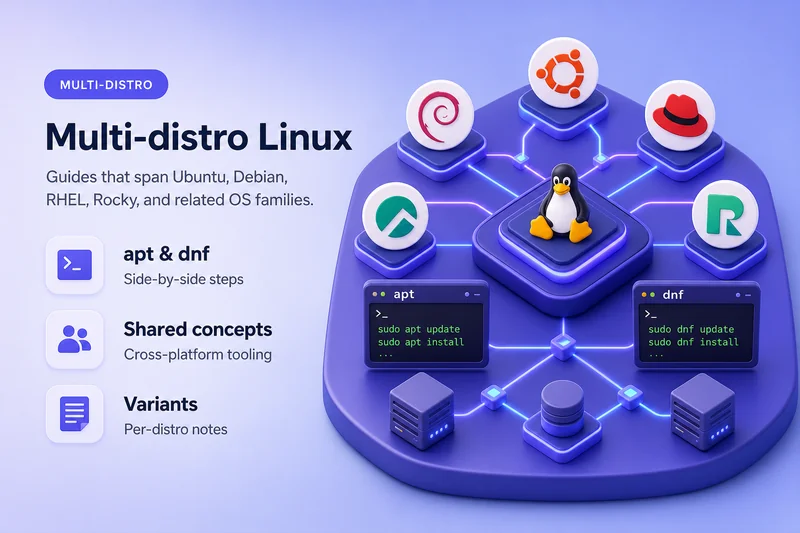
Covers RHEL, Rocky Linux, AlmaLinux, CentOS, CentOS Stream, Fedora, Oracle Linux.
Ubuntu tutorials
Ubuntu Linux guides for LTS and interim releases. apt and snap installs, Netplan networking, systemd services, and desktop or server setup.
Debian tutorials
Debian Linux guides for stable, testing, and unstable. apt and dpkg workflows, systemd, networking, and server or desktop configuration.
Kali Linux tutorials
Kali install, repository, and package guides live in the ethical hacking section—VirtualBox, USB, Android, Apple Silicon, and day-to-day apt tasks on Kali.

Linux Mint tutorials
Linux Mint guides built on the Ubuntu LTS base. apt and dpkg installs, Cinnamon desktop configuration, Update Manager, and driver setup.

Arch Linux tutorials
Arch Linux guides — pacman, AUR workflows, and rolling-release administration.
General Linux guides
Distribution-neutral Linux tutorials—systemd, networking, security, and administration concepts that apply across RHEL-family, Debian-family, and other platforms.
Featured in this section






All Linux articles
Troubleshoot High Load Average in Linux
Troubleshoot Linux high load average by comparing load to CPU count, reading mpstat and iowait, finding D state processes, checking disk and NFS blocking I/O, and identifying whether CPU, I/O, or locks are the …
Troubleshoot Default Routes in Linux
Troubleshoot Linux default route problems by reading ip route show default and ip route get, understanding route metrics, removing wrong gateways, fixing multiple default routes, and making the correct gateway persistent …
Troubleshoot Slow Network Speed in Linux
Troubleshoot Linux slow network speed by measuring throughput with curl and iperf3, checking latency and packet loss, verifying ethtool link speed and duplex, reading interface drops, testing MTU, reviewing routes, and …
Troubleshoot Packet Loss in Linux
Troubleshoot Linux packet loss by confirming drops with ping statistics, locating the failing hop with mtr, reading interface error counters, checking ethtool link state, testing MTU with ping, and comparing local LAN …
Fix NetworkManager Device Unmanaged on Linux
Fix NetworkManager device unmanaged on Linux by reading nmcli device state and reason codes, checking unmanaged-devices rules and NM_CONTROLLED, marking interfaces managed, and verifying with nmcli reload.
Fix Destination Host Unreachable on Linux
Fix destination host unreachable on Linux by identifying which host sent the ICMP error, checking interface IP and routes, resolving ARP neighbor failures, and restoring a reachable default gateway.
Fix Connection Refused on Linux
Fix connection refused on Linux for ssh, curl, and custom TCP ports by confirming host reachability, checking systemd and ss listeners, bind addresses, firewalld rules, and verifying with nc or curl.
Fix Linux: Can Ping IP but Not Hostname
Fix Linux hosts that ping IP addresses but not hostnames by confirming routing, testing DNS with getent and dig, checking resolv.conf and NetworkManager, and restoring working nameservers.
Fix No Route to Host on Linux
Fix no route to host on Linux for ssh, curl, and other TCP clients by checking ip route get, gateway and ARP neighbors, tracepath, and firewalld REJECT rules that return EHOSTUNREACH.
Fix Network Is Unreachable on Linux
Fix network is unreachable on Linux by checking link state and IP addresses, reading ip route get, restoring a missing default gateway, and correcting NetworkManager routes on RHEL, Ubuntu, and other distributions.
Fix Temporary Failure in Name Resolution on Linux
Fix temporary failure in name resolution on Linux by confirming IP connectivity, testing DNS with getent and dig, checking resolv.conf and NetworkManager DNS servers, and applying a working resolver configuration.
How to Find and Fix Memory Leaks in Linux Applications
Read LeakSanitizer and Valgrind reports down to the line that owns the memory, use the flags that add detail, attribute growth with Massif, and query a running process with vgdb so you fix the cause instead of only …
How to Install libc.so.6 on Linux (glibc Package, Not a Download)
Diagnose libc.so.6 errors by message type — GLIBC_2.xx not found, cannot open shared object file, wrong ELF class, or damaged system libc — then fix with the matching glibc package, multilib, rebuild, container, or …
Configure Fail2ban to Protect SSH on Linux
Install Fail2ban, enable the sshd jail with sane bantime and ignoreip values, verify bans after failed SSH logins on RHEL and Debian, and unban trusted client addresses when needed.
Found a Swap File by the Name: Fix Vim .swp Warnings (E325)
Fix Vim E325 Found a swap file by the name by reading the .swp prompt, recovering after a crash, or removing a stale swap file once no editor owns it — not Linux swap memory from mkswap.
Fix SSH No Route to Host: Routing, Firewall, and sshd Checks
Diagnose SSH no route to host with TCP port tests, ip route get, remote firewalld and sshd checks, and learn when the message means a firewall REJECT instead of a missing route.
Run Multiple Commands Over SSH on Linux
Chain remote commands over SSH with semicolons, &&, subshells, bash -s, and here documents, and pick the pattern that matches whether every step must run or stop on failure.
Long-Running Commands Over SSH: Keep Jobs Running After Disconnect
Run backups, builds, and other long jobs over SSH with explicit I/O redirection, nohup, setsid, tmux, or disown so work continues after the terminal closes and output lands in a log you can read later.
Enable UTF-8 Locale on Linux
Set a UTF-8 system locale with localectl or update-locale, confirm with locale and locale charmap, and fix missing-locale warnings on RHEL and Debian-family Linux.
Fix RPM Failed Dependencies on Install and Remove
Fix error Failed dependencies when installing a local RPM with dnf install, list requirements with dnf repoquery, install offline RPM bundles, and remove packages safely on RHEL family systems.
Enable Persistent Logging in systemd-journald on Linux
Store systemd-journald logs on disk under /var/log/journal with a Storage=persistent drop-in, restart systemd-journald, flush runtime logs with journalctl, and verify earlier boots with journalctl --list-boots.
Idle SSH Sessions: Disconnect or Keep Them Alive on Linux
Set ClientAliveInterval and ClientAliveCountMax on sshd to drop unresponsive SSH clients, use ServerAliveInterval on the OpenSSH client to keep sessions alive through NAT, and understand how TCPKeepAlive differs.
Sort Files and Directories by Size with du on Linux
Find the largest directories and files under a path with du piped to sort, using --max-depth for folder totals, -a for individual files, numeric -k filters, and head to keep the top results.
Disable SELinux in Linux (Runtime, Permissive, and Permanent)
Change or disable SELinux on Linux with setenforce for runtime permissive mode, semanage for one domain, grubby --args selinux=0 for permanent disable on RHEL 9 and 10, and a one-time GRUB edit when the system will not …
Detect Rootkits on Linux with rkhunter
Install rkhunter from EPEL or apt, update its signature database, baseline file properties with propupd, run a non-interactive check, and interpret warnings in rkhunter.log on RHEL and Debian-family hosts.
Disable ICMP Timestamp Responses in Linux
Block ICMP timestamp request (type 13) and reply (type 14) on Linux with firewalld rich rules, nftables, iptables, or UFW, then verify from a second host with nping before compliance scans run again.
How to Delay a Reboot in Linux
Delay a Linux reboot for a maintenance window with shutdown -r +minutes, systemctl reboot --when=, or at; notify users, confirm the pending job, and cancel if plans change.
Create a systemd Service Unit in Linux
Create a custom systemd .service unit under /etc/systemd/system/, explain Unit Service and Install sections, start and enable it with systemctl, and verify with status and journalctl.
How to Perform tar Incremental Backup on Linux
Take GNU tar listed-incremental backups with a snapshot file, create level 0 and level 1 archives, inspect Y and N file status, and restore by applying the full backup then each incremental in order.
SSH Multiplexing on Linux: Share One Connection
Reuse one authenticated SSH connection for later ssh, scp, and sftp sessions with ControlMaster, ControlPath, and ControlPersist on the OpenSSH client.