
![Ansible Tutorial for Beginners [RHCE EX294 Exam]](/ansible-tutorial/ansible-tutorial_hu_85e831566074072d.webp)
devops
Ansible Blocks, Rescue, Always, failed_when and changed_when Explained
Learn Ansible error handling with block, rescue, always, failed_when, changed_when, register checks, ignore_errors trade-offs, unreachable hosts, and meta: clear_host_errors.
devops
Ansible Tags Explained: Run and Skip Tasks in Playbooks
Learn Ansible tags to run or skip selected playbook tasks at runtime with --tags, --skip-tags, always, never, play and role tags, and safe partial runs.
devops
Ansible Loops Explained with loop, until, retries and delay
Learn Ansible loops with loop, loop_control, register results, when per item, until retries and delay, and when to use wait_for instead of looping.
devops
Ansible Handlers Explained: Restart Services Only When Tasks Change
Learn Ansible handlers with notify, service restarts, execution order, listen, flush_handlers, loops, roles, changed_when pitfalls, and common troubleshooting mistakes.
devops
Working with managed nodes with password (not passphrase)
Connect Ansible to managed nodes with SSH passwords using --ask-pass (-k), understand -K vs -k, sshpass requirements, and when key-based auth is still preferred on Rocky Linux 10.
devops
Ansible Inventory Files: INI, YAML, Groups, and Variables
Learn how Ansible inventory files list hosts and groups in INI or YAML, where to place variables, how parent and child groups work, and how to verify with ansible-inventory and ping on Rocky Linux 10.
devops
How to Configure ansible.cfg for Ansible Projects on Linux
Configure ansible.cfg at the project root—search order, defaults, inventory path, remote_user, become, roles_path, and verification with ansible --version and ansible-config on Rocky Linux 10.
devops
How to Install Ansible on Rocky Linux 10
Install Ansible on Rocky Linux 10 using ansible-core, EPEL collection RPMs, pipx, or pip. Add ansible-navigator, Podman, verify versions, and run your first ping test.
devops
Ansible Vault Tutorial: Encrypt Variables, Files and Passwords
Learn Ansible Vault to encrypt files and variables with create, view, edit, encrypt, decrypt, rekey, vault IDs, password options, and secure group_vars and host_vars usage.
devops
RHCE EX294 Exam Objectives Explained with Ansible Study Plan
RHCE EX294 objectives explained as a practical Ansible study plan, with RHCSA task mapping, ansible-navigator focus, Rocky Linux lab guidance, and GoLinuxCloud course links.
devops
include_tasks vs import_tasks in Ansible: Difference and Examples
Compare Ansible import_tasks and include_tasks for static vs dynamic task loading, with conditions, loops, tags, apply, list-tasks behavior, and when to use each.
devops
Ansible when Conditional Explained with Facts and Variables
Learn Ansible when conditionals with variables, facts, registered output, lists, dictionaries, loops, block and role level conditions, and common mistakes.
devops
Ansible Variable Precedence Explained with group_vars and host_vars
Learn Ansible variable precedence with a practical order for group_vars, host_vars, play vars, vars_files, role defaults, role vars, and extra vars, plus debugging with ansible-inventory and debug tasks.
devops
Write Your First Ansible Playbook: Package, Service, File, and Copy
Write your first Ansible playbook step by step—project layout, package and service tasks, file and copy modules, become, simple vars, syntax check, check mode, and PLAY RECAP.
devops
How to Run Ansible Playbooks with ansible-playbook and ansible-navigator
Run Ansible playbooks with ansible-playbook and ansible-navigator—inventory, --limit, --syntax-check, --check, --diff, verbosity, tags, become, extra vars, and stdout mode.
devops
Ansible Playbook Structure Explained: Plays, Tasks and Modules
Learn Ansible playbook structure—plays, tasks, modules, hosts, become, vars, handlers, multiple plays, execution order, validation, and common layout mistakes.
devops
Ansible command vs shell vs raw Module: When to Use Each
Compare Ansible command, shell, and raw modules—pipes, argv, creates, removes, changed_when, Python bootstrap, security risks, and when to use dedicated modules instead.
devops
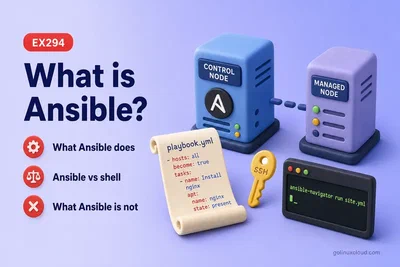
What is Ansible? Architecture, Components and How It Works
Learn what Ansible is, how agentless automation works, and how control nodes, inventory, modules, playbooks, roles, collections, and vault fit together on Rocky Linux.
devops
Ansible Operators and Jinja2 Tests in when Conditions
Learn Ansible comparison and logical operators, Jinja2 tests such as is defined, and safe when expressions for strings, lists, dictionaries, facts, and registered task results.
devops
YAML Syntax for Ansible Playbooks with Examples
Learn YAML syntax for Ansible playbooks—indentation, lists, dictionaries, strings, booleans, multiline values, common mistakes, and ansible-playbook --syntax-check validation.
devops
Ansible Facts and Custom Facts Explained
Learn Ansible facts from the setup module—OS, network, memory, mounts, and Python—plus fact filters, gather_facts control, custom facts.d files, and ansible_local in playbooks and templates.
devops
Ansible Ad Hoc Commands Explained with Examples
Learn Ansible ad hoc command syntax with ping, command, shell, package, service, file, copy, user, become, --limit, check mode, troubleshooting, and playbook migration examples.
devops
Ansible Roles Explained: Directory Structure, Defaults, Vars and Handlers
Learn Ansible roles with a tested demo: directory structure, tasks, handlers, defaults vs vars, variable placement, role dependencies, and when to use roles, include_role, or import_role.
devops
Stop All Docker Containers: Commands, Examples, and Safe Shutdown
Stop all running Docker containers with docker stop $(docker ps -q), handle empty lists safely, adjust timeouts, force-kill stuck containers, filter by label, and shut down Compose stacks without data loss.
devops
Error: can only create exec sessions on running containers
Explore solutions to the Docker error 'can only create exec sessions on running containers: container state improper.
devops
Keep Docker Container Running (5 Easy Methods + Examples & Best Practices)
Learn how to keep a Docker container running using multiple methods like TTY mode, entrypoint, sleep infinity, and process management. Fix containers exiting immediately with practical examples and best practices.
devops
Override Docker Entrypoint (How to Change CMD & ENTRYPOINT with Examples)
Learn how to override Docker ENTRYPOINT and CMD using docker run options. Understand the difference between ENTRYPOINT and CMD with practical examples and best practices.
devops
Docker ps -a Explained (List All Containers with Examples & Filters)
Learn how to use docker ps -a to list all containers including stopped ones. Explore examples, filters, and output details to manage Docker containers effectively.
devops
SSH into Docker Container [3 Simple Methods]
There are 3 different possible methods to perform docker container SSH. Using docker exec, docker attach and by running a SSHD service inside a container and using SSH client to connect to container
devops
Docker Restart Container [Control With Flags]
Docker restart container using various flags to control the restart behavior of the container