A singly linked list is a chain of nodes where each node holds a value (often val or data) and a next pointer to the following node—or null at the tail. You keep a head reference to the first node, prepend in O(1) by rewiring head, or walk forward with a cursor when you need ordered inserts at the end. JavaScript has no built-in linked list in the standard library; you model nodes with plain objects or classes. Arrays cover most ordered collections in apps; for small lists, JavaScript unshift() is the built-in way to prepend while keeping index access. Linked lists stay relevant for interviews, puzzles, and APIs shaped like chains.
Environment: Node.js v20.18.2. Snippets are self-contained; the note after each block states the expected console output.
ListNode shape (javascript listnode)
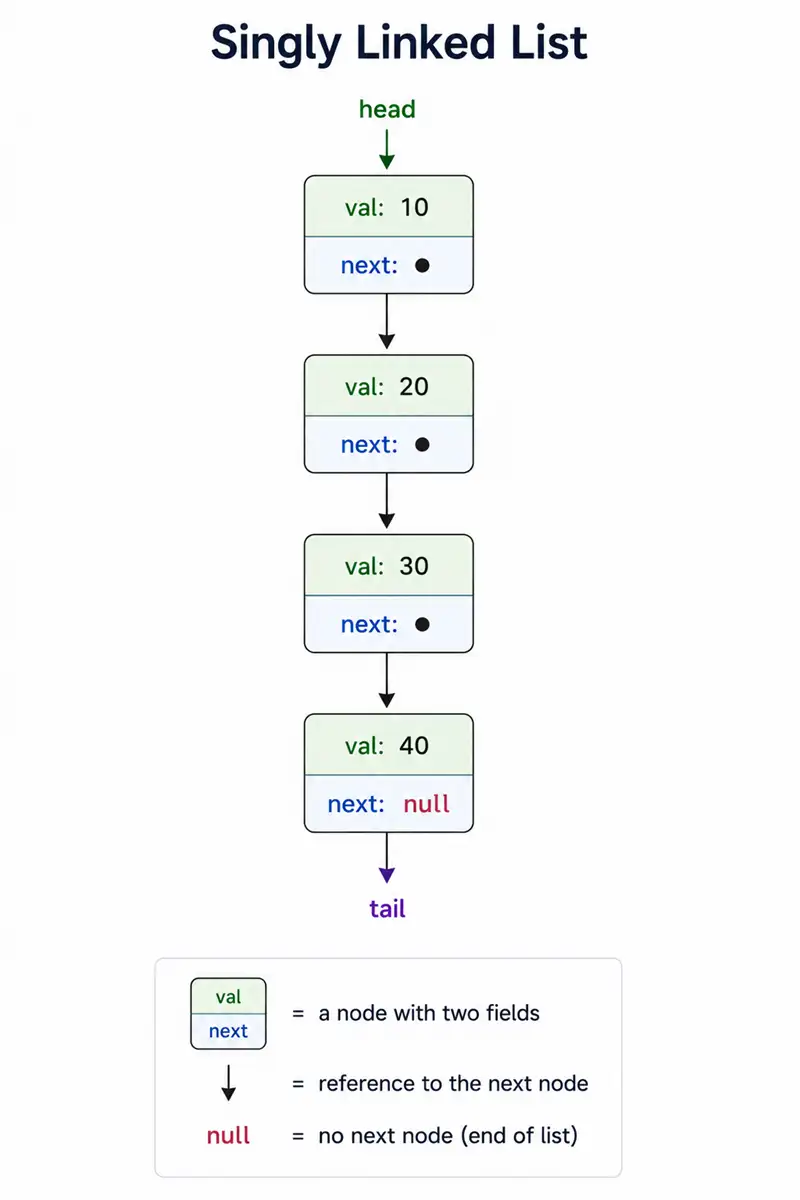
A minimal singly linked pair: the head points at the second node; the tail’s next is null.
const tail = { val: 1, next: null };
const head = { val: 2, next: tail };
console.log(`${head.val}->${tail.val}`);You should see one line logging 2->1.
val matches common listnode examples; you can rename it to data everywhere if you prefer.
How to create a linked list in javascript (forward order)
Build [1,2,3,4,5] in one forward pass by hanging each new node off the previous tail.
function listFromArrayForward(arr) {
  if (arr.length === 0) {
    return null;
  }
  const h = { val: arr[0], next: null };
  let t = h;
  for (let i = 1; i < arr.length; i++) {
    t.next = { val: arr[i], next: null };
    t = t.next;
  }
  return h;
}

const head = listFromArrayForward([1, 2, 3, 4, 5]);
for (let cur = head; cur; cur = cur.next) {
  console.log(cur.val);
}You should see 5 lines, in order: 1, 2, 3, 4, 5.
Prepend by scanning the array backward
Another classic pattern: walk the array from the end toward the start and prepend each value at the head. You still get forward order when you traverse from head.
function createLinkedList(dataArray) {
  let h = null;
  for (let i = dataArray.length - 1; i >= 0; i--) {
    h = { val: dataArray[i], next: h };
  }
  return h;
}

const head = createLinkedList([1, 2, 3, 4, 5]);
for (let cur = head; cur; cur = cur.next) {
  console.log(cur.val);
}You should see 5 lines, in order: 1, 2, 3, 4, 5.
LinkedList class: prepend add and remove
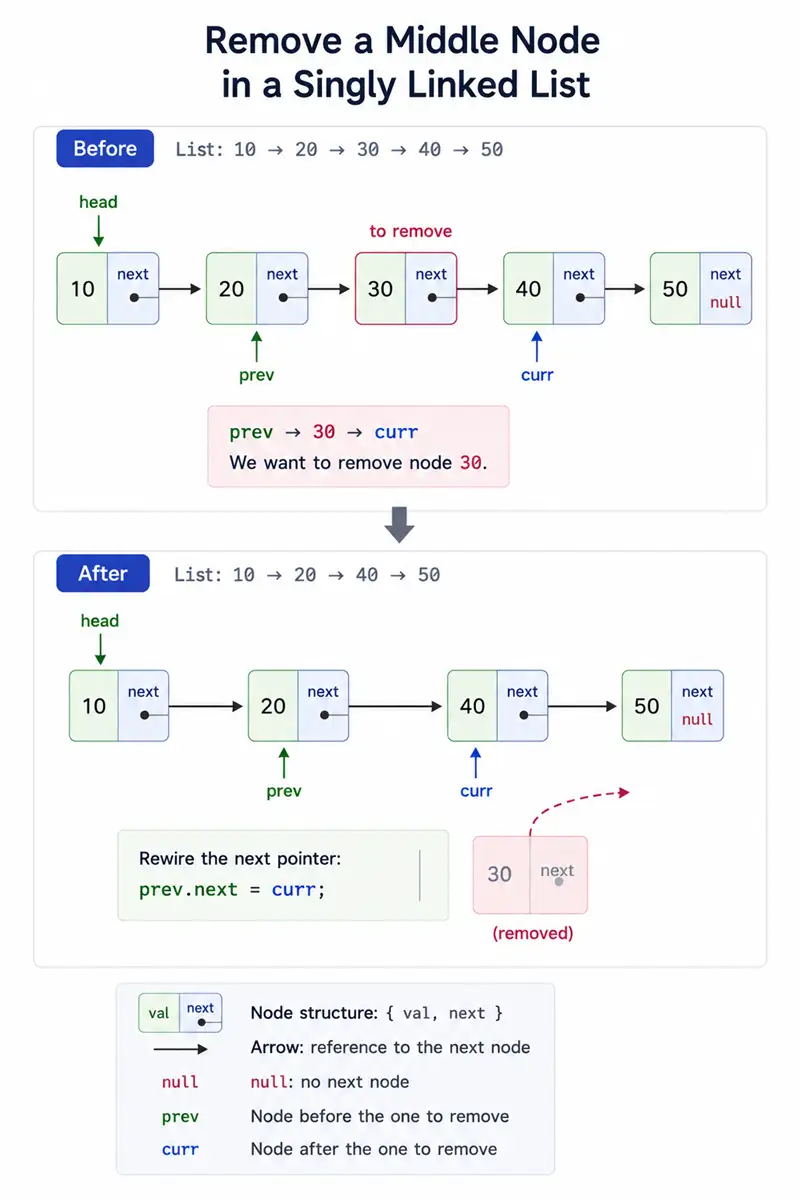
A small class keeps this.head and mutates links when removing the first node whose val matches.
class LinkedList {
  constructor() {
    this.head = null;
  }

  add(val) {
    this.head = { val, next: this.head };
  }

  remove(val) {
    let cur = this.head;
    let prev = null;
    while (cur) {
      if (cur.val === val) {
        if (prev) {
          prev.next = cur.next;
        } else {
          this.head = cur.next;
        }
        return true;
      }
      prev = cur;
      cur = cur.next;
    }
    return false;
  }
}

function vals(h) {
  const a = [];
  for (let n = h; n; n = n.next) {
    a.push(n.val);
  }
  return a;
}

const list = new LinkedList();
list.add("node1 data");
list.add("node2 data");
list.add("node3 data");
list.remove("node2 data");
console.log(JSON.stringify(vals(list.head)));You should see one line logging ["node3 data","node1 data"].
add prepends, so the first string you pass ends up at the far end of the chain; remove splices out the middle link and leaves node3 data → node1 data.
Summary
Linked list javascript and linked list js tutorials should leave you with one mental model: nodes are { val, next } (or data if you rename the field), and algorithms revolve around keeping a correct head pointer while you prepend, append, or splice. People ask how to create a linked list in javascript without a standard library class—either build forward with a tail cursor, or scan an array backward while prepending at the head, both of which preserve order when you traverse from head.
Interview searches for listnode js or javascript listnode are the same structure under LeetCode naming. In production JavaScript you still reach for arrays for cache locality and random access, but understanding singly linked lists matters for exercises, custom queues, and APIs that already expose chain-shaped data—just be disciplined about null checks and pointer order when you delete a middle node.
References
- Using classes - JavaScript | MDN
- Classes - JavaScript | MDN